Introduction
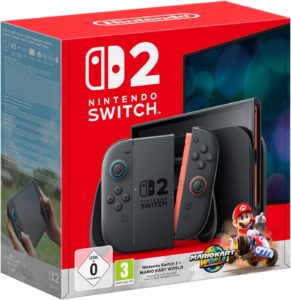
Nintendo’s long-awaited successor to the original Switch, often referred to as the Nintendo Switch 2, launched on June 5, 2025. Positioned as an evolutionary upgrade rather than a radical new direction, the Switch 2 seeks to refine and expand upon the strengths of its predecessor. At the heart of its rollout is Mario Kart World, a flagship title designed to showcase the console’s enhanced capabilities and to act as the definitive launch-day experience. In this review blog, we’ll dissect both the hardware innovations of the Switch 2 and the gameplay, design, and overall impact of Mario Kart World. Throughout, we will draw on early hands-on impressions and technical analyses to gauge whether this package is worth the premium price of $449.99 (or $499.99 bundled with Mario Kart World).
Nintendo Switch 2: Hardware and Design
Design and Build Quality
At first glance, the Switch 2 retains the familiar form factor of its predecessor, but with noticeable refinements. The console is physically larger, featuring a 7.9-inch Full HD LCD touchscreen (compared to the original Switch’s 6.2-inch panel), and it sports a sleeker bezel design. The plastic casing feels more premium, with matte finishes replacing much of the glossy surfaces that were prone to fingerprints on the original Switch. The new Joy-Con 2 controllers attach magnetically, addressing longstanding complaints about the fiddly sliding rails on the older model. Many users have praised the satisfying “clunk” when connecting the Joy-Cons, which feels both sturdy and intuitive.
Dimensions: 7.9-inch diagonal screen, roughly 0.5 inches thicker than the original.
Weight: Slightly heavier at 320 g for the handheld unit (original was ~297 g), but well balanced.
Overall, the build quality feels more robust, and the thicker chassis accommodates beefier internals and better heat dissipation, particularly important for native 4K output when docked.

Display and Audio
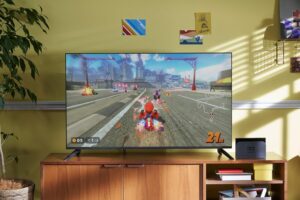
The 7.9-inch 1080p LCD screen is a significant leap over the previous 720p panel, offering crisper visuals and far better HDR support. In handheld mode, games render at 1080p, and the reduced “screen door” effect seen in the original model is virtually eliminated. Colors are vibrant, blacks are deep enough to deliver solid contrast, and the 120 Hz refresh rate ensures ultra-smooth animations—particularly noticeable in fast-paced titles like Mario Kart World.
When docked, the Switch 2 can output up to 4K at 60 fps or 1080p at 120 fps. Early performance tests show that first-party titles like Mario Kart World consistently hit their target framerates, though third-party AAA games may need to dial down some graphical settings to maintain stability.
The audio subsystem receives a modest—but meaningful—upgrade with stereo speakers that sound fuller and more dynamic. During intense races in Mario Kart World, engine growls and shell blasts come through with clarity, though extremely busy soundscapes can still get slightly muddled. Overall, the enhanced stereo output is a welcome balance between handheld portability and immersive audio.
Performance and Internals
Under the hood, the Switch 2 is powered by a custom NVIDIA-based system on a chip (SoC) architected around circa-2021 mobile technology, offering a substantial boost over the original Switch’s 2014–
era chipset. The exact specifications remain proprietary, but benchmarks from early reviewers indicate approximately twice the GPU performance and a roughly 1.5× to 2× CPU uplift, depending on the workload.
Key performance highlights:
Handheld Mode: Native 1080p rendering with 60–120 fps in most first-party titles.
Docked Mode: 4K output capped at 60 fps; 1080p at 120 fps for select titles.
Storage: 256 GB internal SSD with UHS-III microSD compatibility; install sizes for Switch 2 games range from 10–30 GB.
The additional storage is a boon for digital-only users, though microSD cards remain necessary for large libraries. Boot and load times are noticeably reduced compared to the original Switch, reducing downtime between races in Mario Kart World’s multiple event modes.
Controls
The new Joy-Con 2 controllers maintain the same button layout and motion controls but feel more ergonomic, thanks to slightly larger grips and improved thumbstick tension. Button travel is crisper, and the drift issues that plagued earlier Joy-Con sticks appear less prevalent, likely owing to refined analog components. The Joy-Con 2s can also function as wireless Bluetooth controllers when detached, with minimal latency.

Battery Life and Cooling
Battery life in handheld mode hovers around 5–7 hours for less demanding titles, and 3–4 hours for GPU-intensive games running at higher refresh rates (e.g., 120 fps). In practice, playing Mario Kart World on the go yields around 4.5 hours before a recharge is required—roughly on par with the Switch OLED when pushing 1080p60 settings.
The improved internal cooling system, featuring a larger heatsink and more efficient airflow, helps maintain sustained performance. Even during extended docked sessions at 4K60, thermal throttling is minimal, ensuring stable frame delivery.
Software Features and Backward Compatibility
Nintendo introduces several software innovations with Switch 2:
Nintendo GameChat: A built-in voice/video chat system supporting up to 12 concurrent users, with low overhead and seamless party invitations.
USB-C Camera Accessory: An optional peripheral for augmented reality (AR) interactions and video calls. Limited first-party titles (e.g., Animal Crossing: Memories) leverage the camera for image-based avatar creation.
Upgraded eShop: Featuring dynamic storefronts, richer media previews, and faster downloads via the SSD.
In terms of backward compatibility, the Switch 2 supports most original Switch cartridges and digital titles. However, a handful of older third-party games exhibit minor glitches or frame-rate drops, as they haven’t been fully optimized for the new hardware. Nintendo promises patches in the coming months to address these issues. Joy-Con 1 controllers, Pro Controllers, and older accessories remain compatible, though you may need a firmware update to sync them properly.

Mario Kart World: Game Review
Overview and Concept
Mario Kart World is Nintendo’s ninth mainline Mario Kart installment, though it eschews numerical branding to emphasize its ambition as a “living world” rather than a simple collection of discrete cups. Released as a launch title for Switch 2 (priced at $79.99 / £74.99), Mario Kart World aims to redefine the series by introducing a semi-open world hub that interconnects classic and new tracks via seamless transitions.
The core concept revolves around a hub overworld where players can freely explore a miniature Mario universe, encountering story balloons, hidden collectibles, and impromptu races before diving into the main circuit events. This shift from the traditional “cups” format to a world-connected structure allows for a more immersive experience, though the traditional cup selection remains accessible for purists.
Graphics and Visuals
Mario Kart World runs at 1080p 60 fps in handheld mode and 4K 60 fps when docked. The game boasts meticulous track designs that blend classic locales—such as Moo Moo Meadows and Rainbow Road—with entirely new courses that leverage Switch 2’s graphical horsepower. Textures appear sharper, and environmental details (like water reflections and dynamic lighting) are significantly enhanced compared to Mario Kart 8 Deluxe.
Character Models: Each racer features a higher polygon count and more detailed animations. You can spot dirt specks on Goombas or visible wear on kart tires.
Track Detail: Transitions between track segments in the open world are seamless, with minimal load screens—often just quick fades during high-speed jumps.
Effects: Particle effects (e.g., mushroom boosts, banana dispersal) are more pronounced, and motion blur is used sparingly to maintain clarity at 60 fps.
Overall, Mario Kart World sets a new graphical benchmark for the series, making full use of the Switch 2’s capabilities.
Gameplay Mechanics and Features
While retaining the beloved core mechanics—drifting, item use, character-specific weights, and vehicle customizations—Mario Kart World introduces several notable innovations:
24-Player Races: For the first time, up to 24 racers can compete simultaneously, doubling the usual 12. This leads to chaotic, large-scale battles, especially in busier circuits.
World Map and Free Roam: The semi-open world allows players to drive from one track to another in a cohesive environment. Hidden shortcuts, collectible stickers, and mini-challenges dotted throughout encourage exploration.
Jump Mechanic: A new “skill jump” enables racers to hop over obstacles or reach elevated pathways. Mastering timing for jumps unlocks alternate routes, making track navigation more dynamic.
Knockout Tour Mode: Instead of the classic cup structure, this mode pits you in a gauntlet where the last-place racer is eliminated after each lap, culminating in a final duel. It infuses tense, survival-based excitement into the traditional formula.
Supervivencia (Survival) Mode: A Spanish-named “Supervivencia” mode drops players into a shrinking arena filled with hazards. Last racer standing claims the crown—analogous to a battle royale but kart-based.
Stickers and Customization: In lieu of deeply customizable vehicle parts, Mario Kart World uses stickers as the primary cosmetic unlock. These can be affixed to karts to show off achievements, and there are over 200 to collect.
These additions inject fresh life into the franchise while preserving the accessibility that has made Mario Kart a household staple.

Sound and Music
Mario Kart World features a revamped orchestral soundtrack drawing heavily on series classics. Tracks like “Toad Circuit” and “Bowser Castle” are reimagined with richer instrumentation, while new compositions preview settings such as Koopa Wasteland and Electro City. Overall, the audio design complements the high-speed action, though in crowded online races the mix can become cluttered—engines, shells, and music sometimes overlap, making it tricky to discern subtle audio cues.
Voice lines from announcers and AI-driven crowd noise add energy to every event, reinforcing the immersive atmosphere. Furthermore, the Mario Kart World engine leverages the Switch 2’s improved audio codec to deliver crisper, more distinct sound across both speakers and headphones.
Multiplayer and Online
Multiplayer remains the cornerstone of Mario Kart World. The game supports:
Online Matches: Up to 24 players per race, with regional matchmaking to minimize latency. Connection stability is generally solid, though some users have reported occasional frame drops in particularly data-heavy matches (e.g., 24-player Rainbow Road).
LAN Play: For local wireless competitions, up to 12 players can connect via local networks. Performance is almost flawless, thanks to the Switch 2’s upgraded Wi-Fi 6E radio.
Split-Screen: In docked mode, two players can share the same screen, with dynamic split adjustments ensuring minimal performance impact.
Despite the robust infrastructure, custom lobbies and private matches have a slightly dated interface that some players find unintuitive. Options for round-robin tournaments, spectator modes, or cross-region party creation are limited, leaving room for future updates.
Controls and Feel
Mario Kart World shines in how it blends precision controls with approachable drifting mechanics. The improved Joy-Con 2 sticks offer tighter responsiveness, letting skilled players maintain drifts more consistently. The new skill jump is easy to execute—press and hold the drift button, then tap jump at the apex of a curve. Mastery of this technique opens up hidden shortcuts on several tracks.
For newcomers, the Smart Steering Assist and Auto-accelerate options remain available, ensuring that even novices can enjoy the thrill of racing without feeling overwhelmed.
Value Proposition and Conclusion
Bundled Value
Nintendo offers a Mario Kart World bundle for $499.99, which includes:
Nintendo Switch 2 console (256 GB)
Dock with HDMI cable and power adapter
Pair of Joy-Con 2 controllers (neon blue/red)
Mario Kart World (digital download code)
Considering standalone prices—$449.99 for the console and $79.99 for the game—the bundle represents a modest discount of about $30. Given Mario Kart World’s role in showcasing the console’s strengths (4K60, 120 fps handheld, new modes), the bundle makes sense for anyone immediately drawn to the new game.
Pros and Cons
Pros:
Refined Hardware: Improved screen, Joy-Con design, internal SSD, and robust performance.
Backward Compatibility: Virtually all original Switch titles and accessories work seamlessly.
Visual Leap: Native 1080p handheld, 4K docked, HDR, and up to 120 fps support.
Launch Title Excellence: Mario Kart World is a technically polished, feature-rich game that exemplifies the Switch 2’s potential.
Innovative Game Mechanics: Semi-open world, 24-player races, skill jumps, and new modes reinvigorate the series.
Cons:
High Entry Price: At $450 (or $500 bundled), it’s a premium purchase, especially for owners of the Switch OLED.
Launch Game Focus: While Mario Kart World is outstanding, the broader launch library is modest, with few exclusives beyond upgraded ports.
Online Limitations: Custom lobby features and spectator modes feel antiquated compared to competing platforms.
Battery and Noise: Intensive games at high framerates drain the battery faster (3–4 hours), and the console can become moderately loud under load.
Overall Recommendation
For Switch newcomers, the Switch 2 + Mario Kart World bundle is a compelling introduction to Nintendo’s ecosystem, offering top-tier portability, strong performance, and a showcase title that maximizes hardware strengths. For original Switch owners, the decision hinges on how much value you place on native 1080p/4K output, stable 60 fps, and anticipated future exclusives that leverage Switch 2’s horsepower. Owners of the Switch OLED may find the upgrade less urgent, given that OLED already offered solid handheld performance (albeit at 720p60).
Mario Kart World is arguably the best first-party launch game Nintendo has produced in years—ambitious in scope, mechanically rich, and visually spectacular. Its blend of classic nostalgia and modern innovations ensures a satisfying experience for both veterans and newcomers to the franchise.
In summary, the Nintendo Switch 2 achieves its goal of refining the hybrid concept: it maintains the Switch’s hallmark flexibility while offering substantial enhancements in display quality, performance, and design. Mario Kart World cements itself as a must-play, proving that this hardware iteration is not just a minor refresh but a meaningful step forward. For those eager to embrace Nintendo’s next generation of hybrid gaming, this package delivers on multiple fronts—albeit at a premium price.